
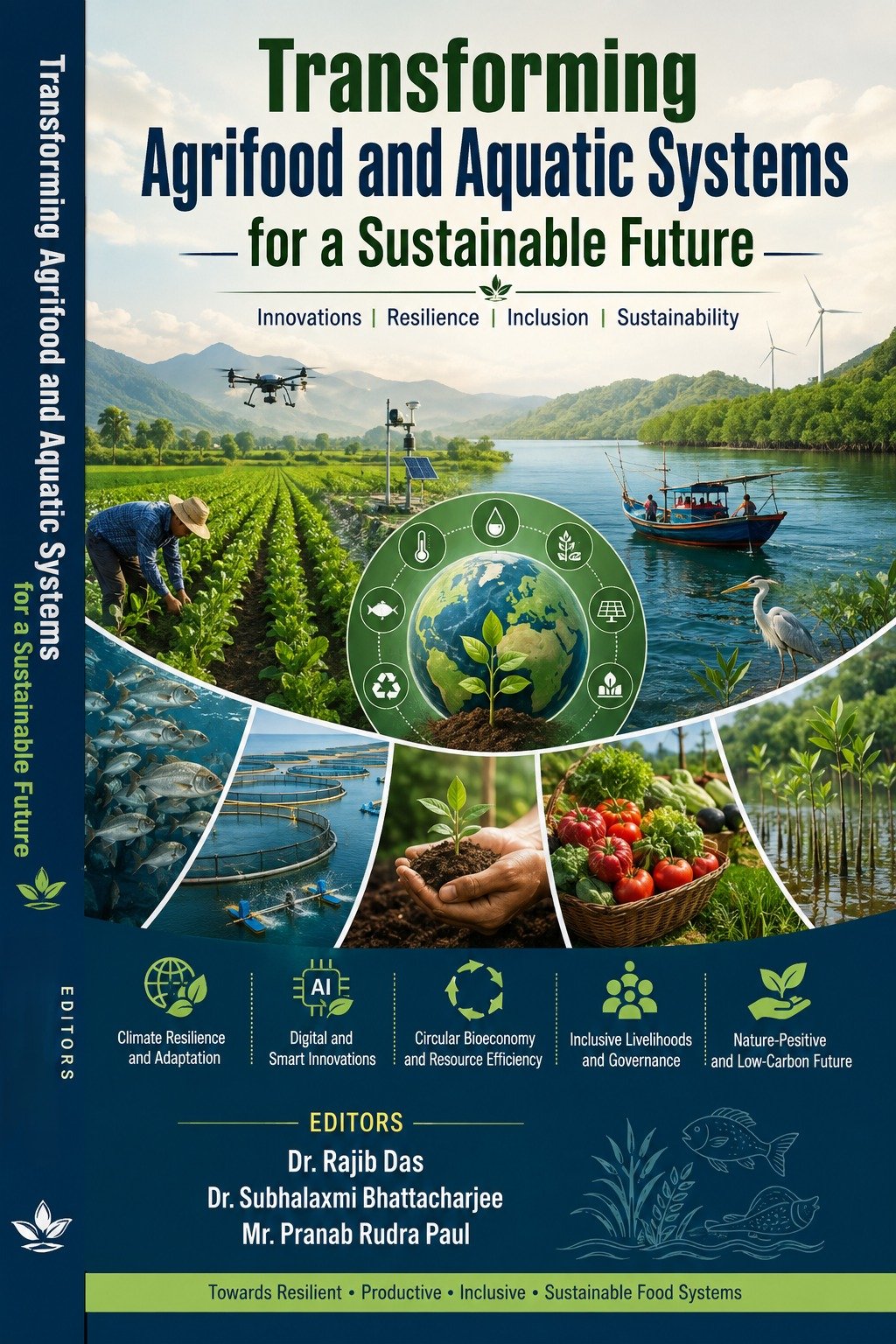
About This Book
Proposed Edited Book Structure (Call/ Whatsapp to: +91 9862629811)
TRANSFORMING AGRIFOOD AND AQUATIC SYSTEMS FOR A SUSTAINABLE FUTURE
Section I. Foundations and Emerging Paradigms
|
Ch. |
Chapter Title |
Subtitle |
Major points to be covered |
|
1 |
Transforming Agrifood and Aquatic Systems: Concepts and Emerging Paradigms |
From Sectoral Production to Integrated, Resilient and Sustainable Food Systems |
• Concept of agrifood and aquatic systems • Drivers of transformation • Food–water–energy–ecosystem nexus • Systems thinking • Sustainability dimensions • Global transformation pathways |
|
2 |
Global Food-System Transformation and the Sustainable Development Goals |
Linking Food Production with Nutrition, Livelihoods and Environmental Sustainability |
• SDGs and food systems • Food security and nutrition • Poverty and livelihoods • Sustainable production and consumption • Trade-offs and synergies • SDG-based approaches |
|
3 |
Climate Change and the Future of Agrifood and Aquatic Systems |
Risks, Vulnerabilities and Adaptation Pathways |
• Climate impacts on crops, livestock and fisheries • Temperature and rainfall variability • Ocean warming and aquatic ecosystems • Extreme events • Climate vulnerability • Adaptation and mitigation strategies |
Section II. Climate-Resilient and Sustainable Agriculture
|
Ch. |
Chapter Title |
Subtitle |
Major points to be covered |
|
4 |
Climate-Smart Agriculture for Resilient Food Production |
Technologies and Practices for Adaptation, Mitigation and Productivity |
• CSA principles • Climate-resilient crops • Water management • Conservation agriculture • Weather-based advisories • Carbon management • Scaling CSA |
|
5 |
Regenerative Agriculture and Soil Health |
Rebuilding Soil Function for Sustainable Food Production |
• Soil organic carbon • Soil biodiversity • Reduced tillage • Cover crops • Crop diversification • Biofertilizers • Regenerative farming indicators |
|
6 |
Agroecology and Nature-Positive Agriculture |
Integrating Biodiversity, Ecological Processes and Farm Productivity |
• Agroecological principles • Ecological intensification • Biodiversity • Natural pest regulation • Pollinator conservation • Ecosystem services • Case studies |
|
7 |
Water-Smart Agriculture |
Sustainable Management of Water Resources under a Changing Climate |
• Agricultural water demand • Irrigation efficiency • Micro-irrigation • Rainwater harvesting • Water-saving crops • Groundwater depletion • Water–food nexus |
|
8 |
Sustainable Intensification of Crop and Livestock Production |
Producing More with Fewer Resources |
• Sustainable intensification • Resource-use efficiency • Integrated crop–livestock systems • Nutrient management • Feed efficiency • Emission reduction • Productivity–environment trade-offs |
Section III. Sustainable Fisheries and Aquaculture (Call/ Whatsapp to: +91 9862629811)
|
Ch. |
Chapter Title |
Subtitle |
Major points to be covered |
|
9 |
Blue Transformation and Sustainable Aquatic Food Systems |
Reimagining Fisheries and Aquaculture for Food and Nutrition Security |
• Blue Transformation • Aquatic foods • Fisheries sustainability • Aquaculture growth • Nutrition • Livelihoods • Policy frameworks |
|
10 |
Climate-Resilient Fisheries and Aquaculture |
Adapting Aquatic Food Production to Environmental Change |
• Climate impacts on fish • Ocean warming • Water quality • Disease emergence • Adaptive aquaculture • Resilient species • Risk management |
|
11 |
Sustainable Aquaculture Intensification |
Improving Productivity while Reducing Environmental Footprints |
• Sustainable intensification • Stocking density • Feed efficiency • Water quality • Biosecurity • Effluent management • Carrying capacity |
|
12 |
Integrated Agriculture–Aquaculture Systems |
Closing Nutrient Loops between Land and Water |
• Rice–fish systems • Fish–livestock integration • Pond-based farming • Nutrient recycling • Integrated farming models • Productivity • Economic benefits |
|
13 |
Innovations in Fish Nutrition and Sustainable Aquafeeds |
Alternative Ingredients, Feed Efficiency and Circular Aquaculture |
• Fishmeal/fish-oil alternatives • Plant proteins • Insect-based feed • Algae • Feed additives • Precision feeding • Feed conversion ratio • Environmental footprint |
|
14 |
Sustainable Fisheries Management and Aquatic Biodiversity Conservation |
Balancing Food Production, Ecosystem Health and Livelihoods |
• Fisheries governance • Overfishing • Habitat degradation • Fish biodiversity • Ecosystem-based fisheries management • Inland fisheries • Community participation |
Section IV. Biodiversity, Ecosystems and Natural Resources (Call/ Whatsapp to: +91 9862629811)
|
Ch. |
Chapter Title |
Subtitle |
Major points to be covered |
|
15 |
Agricultural Biodiversity and Ecosystem Services |
Harnessing Nature for Sustainable Food Production |
• Agrobiodiversity • Genetic resources • Pollination • Biological control • Nutrient cycling • Soil services • Biodiversity–productivity relationships |
|
16 |
Wetlands, Rivers and Watersheds in Sustainable Food Systems |
Connecting Terrestrial Agriculture with Aquatic Ecosystems |
• Wetland ecosystems • River health • Watershed management • Fisheries • Agriculture–water interactions • Wetland agriculture • Ecosystem restoration |
|
17 |
Agroforestry and Landscape Approaches to Sustainability |
Integrating Trees, Crops, Livestock and Ecosystem Services |
• Agroforestry models • Carbon sequestration • Biodiversity • Soil conservation • Climate resilience • Livelihood diversification • Landscape restoration |
|
18 |
Blue Carbon, Coastal Ecosystems and Sustainable Livelihoods |
Linking Mangroves, Fisheries and Climate Mitigation |
• Mangroves • Seagrass • Coastal wetlands • Blue carbon • Fisheries productivity • Coastal communities • Restoration • Carbon markets |
Section V. Circular Economy and Resource Efficiency (Call/ Whatsapp to: +91 9862629811)
|
Ch. |
Chapter Title |
Subtitle |
Major points to be covered |
|
19 |
Circular Bioeconomy in Agrifood Systems |
Converting Biological Resources and Wastes into Sustainable Value |
• Circular economy principles • Bioeconomy • Biomass utilization • Resource recovery • Bioproducts • Nutrient recycling • Circular business models |
|
20 |
Agricultural Waste Valorization and Bio-Based Products |
From Farm Residues to Resources |
• Crop-residue management • Compost • Biochar • Biogas • Bioenergy • Biomaterials • Biofertilizers • Value-added products |
|
21 |
Fishery and Aquaculture Waste Valorization |
Towards Zero-Waste Aquatic Food Production |
• Fish processing waste • Fish silage • Fish protein hydrolysates • Collagen • Chitosan • Fish oil • Biofertilizers • Circular aquaculture |
|
22 |
Food Loss, Waste and Sustainable Value Chains |
Reducing Resource Losses from Farm to Consumer |
• Causes of food loss • Post-harvest management • Cold chains • Fish spoilage • Storage technologies • Processing • Food waste recycling • Consumer behaviour |
Section VI. Digital Transformation and Emerging Technologies (Call/ Whatsapp to: +91 9862629811)
|
Ch. |
Chapter Title |
Subtitle |
Major points to be covered |
|
23 |
Artificial Intelligence in Agriculture, Fisheries and Aquaculture |
From Data-Driven Decisions to Autonomous Food Production |
• Machine learning • Generative AI • Crop prediction • Pest/disease detection • Yield forecasting • Fish identification • Aquaculture monitoring • AI limitations and ethics |
|
24 |
Precision Agriculture and Smart Farming Technologies |
Sensors, IoT, Drones and Data-Driven Resource Management |
• IoT • Sensors • Drones • Variable-rate technologies • Precision irrigation • Precision nutrient management • Smart machinery • Farm decision-support systems |
|
25 |
Remote Sensing, GIS and Earth Observation for Sustainable Food Systems |
Monitoring Crops, Water, Fisheries and Ecosystem Change |
• Satellite imagery • GIS • Crop monitoring • Land-use change • Drought monitoring • Water resources • Fisheries habitat • Environmental assessment |
|
26 |
Digital Aquaculture and Smart Fisheries Management |
Intelligent Monitoring, Automation and Predictive Management |
• Smart sensors • Automated feeding • Water-quality monitoring • Computer vision • Fish behaviour • Digital twins • Traceability • Predictive analytics |
Section VII. Biotechnology, Innovation and Sustainable Production (Call/ Whatsapp to: +91 9862629811)
|
Ch. |
Chapter Title |
Subtitle |
Major points to be covered |
|
27 |
Biotechnology for Sustainable Agriculture and Aquaculture |
Harnessing Biological Innovations for Resource-Efficient Production |
• Microbial biotechnology • Biofertilizers • Biopesticides • Probiotics • Molecular breeding • Aquaculture biotechnology • Biosensors • Regulatory considerations |
|
28 |
Genomic and Breeding Approaches for Climate-Resilient Crops and Fish |
Accelerating Genetic Improvement for Future Food Security |
• Conventional breeding • Genomics • Marker-assisted selection • Genomic selection • Climate-resilient varieties • Disease resistance • Aquaculture breeding • Genetic diversity |
|
29 |
Biological Pest and Disease Management |
Reducing Dependence on Chemical Inputs |
• Biocontrol agents • Microbial pesticides • Botanical pesticides • IPM • Pest forecasting • Resistance management • Ecological approaches • Farmer adoption |
Section VIII. People, Livelihoods, Governance and Markets (Call/ Whatsapp to: +91 9862629811)
|
Ch. |
Chapter Title |
Subtitle |
Major points to be covered |
|
30 |
Smallholders, Fishers and Rural Livelihoods in the Transition to Sustainability |
Making Agrifood Transformation Inclusive |
• Smallholder farmers • Fishers • Livelihood diversification • Vulnerability • Income security • Social protection • Resilience • Inclusive innovation |
|
31 |
Women and Youth in Sustainable Agrifood and Aquatic Systems |
From Participation to Leadership and Entrepreneurship |
• Gender roles • Women's contribution • Youth entrepreneurship • Skill development • Digital inclusion • Access to finance • Leadership • Rural employment |
|
32 |
Farmer Producer Organizations, Cooperatives and Collective Action |
Strengthening Smallholder Participation in Sustainable Value Chains |
• FPOs • Cooperatives • Collective marketing • Input procurement • Value addition • Bargaining power • Governance • Digital platforms |
|
33 |
Indigenous and Traditional Knowledge for Sustainable Resource Management |
Connecting Local Knowledge with Modern Science |
• Traditional farming • Indigenous fisheries practices • Local biodiversity knowledge • Traditional water management • Knowledge documentation • Scientific validation • Knowledge integration |
|
34 |
Sustainable Agrifood Value Chains and Market Transformation |
From Production-Centred Systems to Consumer-Responsive Food Systems |
• Value-chain analysis • Market access • Traceability • Certification • Sustainable products • Farmer–consumer linkages • E-commerce • Premium markets |
|
35 |
Policy, Institutions and Governance for Sustainable Food-System Transformation |
Creating an Enabling Environment for Systemic Change |
• Policy instruments • Institutional coordination • Environmental governance • Fisheries regulations • Agricultural policy • Climate policy • Multi-stakeholder governance |
Section IX. Measuring and Financing Sustainability (Call/ Whatsapp to: +91 9862629811)
|
Ch. |
Chapter Title |
Subtitle |
Major points to be covered |
|
36 |
Measuring Sustainability in Agrifood and Aquatic Systems |
Indicators, Metrics and Assessment Frameworks |
• Sustainability indicators • Environmental footprint • Carbon footprint • Water footprint • Biodiversity indicators • Life-cycle assessment • Resilience indicators |
|
37 |
Carbon-Neutral and Low-Emission Agrifood Systems |
Pathways towards Net-Zero Food Production |
• Agricultural GHG emissions • Methane • Nitrous oxide • Carbon sequestration • Low-carbon farming • Renewable energy • Carbon accounting • Net-zero pathways |
|
38 |
Sustainable Finance and Investment in Agrifood and Aquatic Systems |
Financing the Transition towards Resilient Food Systems |
• Green finance • Climate finance • ESG • Sustainable investment • Carbon markets • Blended finance • Risk management • Financing smallholders |
Section X. Future Pathways (Call/ Whatsapp to: +91 9862629811)
|
Ch. |
Chapter Title |
Subtitle |
Major points to be covered |
|
39 |
Future Food Systems: Scenario Planning and Emerging Trends |
Preparing Agrifood and Aquatic Systems for 2050 and Beyond |
• Future food demand • Population growth • Climate scenarios • Technological disruption • Alternative proteins • Urbanization • Consumer trends • Scenario modelling |
|
40 |
Pathways towards Resilient, Inclusive and Nature-Positive Food Systems |
Integrating Climate, Biodiversity, Technology and Livelihoods |
• Systems integration • Nature-positive production • Climate resilience • Circularity • Digital transformation • Equity • Governance • Scaling innovations |
|
41 |
Transforming Agrifood and Aquatic Systems: A Roadmap for a Sustainable Future |
From Innovation to Implementation and Impact |
• Major transformation pathways • Priority interventions • Policy roadmap • Technology adoption • Institutional mechanisms • Investment priorities • Regional approaches • Future research agenda |